Explore
Science & Philosophy
Explore the ideas that inform our understanding, from the nervous system and brain activity to body rhythms, sensory experience and studies of consciousness.
Our approach
A relational way to evolve
Dreamwave brings together different ways of understanding human experience, from science and philosophy to embodied knowledge, consciousness studies and relational ways of knowing.
Over time, we have explored how these perspectives connect with one another, and how they can help us better understand experience, change and transformation.
At the heart of our approach is a relationship between experience, knowledge and integration.
Learning becomes meaningful when it can be experienced, understood and integrated into how we live.
The foundations
The Mandala
The Mandala brings together the core foundations that inform how we understand and explore the practice.
Over the years, we have explored different fields of science and philosophy and discovered how deeply they can connect with one another. We bring these perspectives together in a structure that gives shape to the practice while leaving room for movement, discovery and continued exploration.
The Mandala is a framework we use to hold this complexity in relationship, creating structure while allowing the practice to remain fluid and evolving.
Seven perspectives. One interconnected field.
Each perspective offers a different way of looking. Together, they help us explore the complexity of human experience and the many dimensions of change.
Change & polarity
Understanding Change
Change can move through different states, perspectives and directions. We explore transformation through the relationship between seemingly opposite experiences, allowing each to inform and reshape the other.
Transformation can move through both sides of a polarity.
We make space for expansion and contraction, questioning and rebuilding, inner experience and outer reality, individual experience and collective life, recognizing that each can reveal something about the other.
The shape of change
Change moves in cycles
Change rarely moves in a straight line. We return to the same questions, patterns and places again and again, each time meeting them a little differently.
For Dreamwave, transformation becomes meaningful through four connected movements, each one informing the others.
Making sense of what we notice, learn and encounter.
Understanding
Integrating
Bringing new understanding and experience into how we relate, choose, respond and live.
Experiencing
Meeting what is happening through sensation, perception, emotion and awareness.
Embodying
Allowing what we discover to become felt, lived and expressed through the body and our ways of being.
These movements flow into one another, each time opening something new.
Each cycle can reveal another layer.

Experience.
Knowledge.
Integration.
Transformation.
A map of change
12 Stages of Transformation
A framework for how change moves through the body.
Movement rarely runs in a straight line. It rises and opens, contracts and reorganizes, settles and begins again, the same expansion and contraction, deconstruction and reconstruction we explore throughout this page, traced here as one continuous rhythm. This particular shape draws on the hero's journey, reworked over years of witnessing how change actually moves through many different bodies. Each of the twelve stages marks a moment within that rhythm, one you can enter or return to at any point.
The twelve stages give language to what's already moving underneath, the parts of change that are easy to feel and hard to name.
This rhythm shapes how we build a live playlisting journey, and it's what we observe in how we facilitate and hold a session.
Sound & experience
Sound as a pathway through experience
Sound shapes how we experience time, space, sensation and attention. In Dreamwave, it becomes an active part of how a session unfolds.
Sound as a multilayered experience
The sound in a Dreamwave session draws primarily from sounds, noises, textures and layered elements, rather than melody alone. Frequencies, rhythms, densities and textures combine and shift, shaping an evolving soundscape. The body meets this as much as the ear does.
Vibration
Sound is felt as much as it is heard. Its vibration moves through the body directly, beneath conscious attention.
Attention
Sound can draw awareness toward a sensation, a rhythm, or the space around you, or let it settle and rest. It shapes where attention goes, and how it moves.
Time & space
A held tone or a shifting rhythm changes how time and space are perceived. A session can feel longer, shorter, closer or wider than it is.
Layering
Multiple sounds moving together create depth and movement. Layering gives sound a sense of dimension, something to listen to and move through.
Frequency
Different frequencies carry different qualities, some felt low in the body, others bright and immediate. Their combination shapes the character of a soundscape.
Rhythm
Rhythm creates movement and anticipation. A shift in rhythm can open a new phase of a session, or invite a return to stillness.
Brainwaves
Brain activity moves through different patterns of organization and attention. Sound can accompany these shifts, offering a rhythm the body can follow.
Wake & dream states
Sound can accompany the drift between waking and dreaming, and the states that can open in between. We expand the REM (rapid-eye movement) stage.
Sound & facilitation
A facilitator observes what is unfolding in the room, and sound becomes part of the response.
A session can draw on a carefully prepared playlist, a playlist built specifically for that session, or live playlisting in the moment. It might layer multiple sounds together, or bring in instruments, voice and other sensory elements when they serve what's unfolding.
Playlisting is its own practice: selecting, layering, sequencing and combining sound with an understanding of the body, perception and the movement of a session.
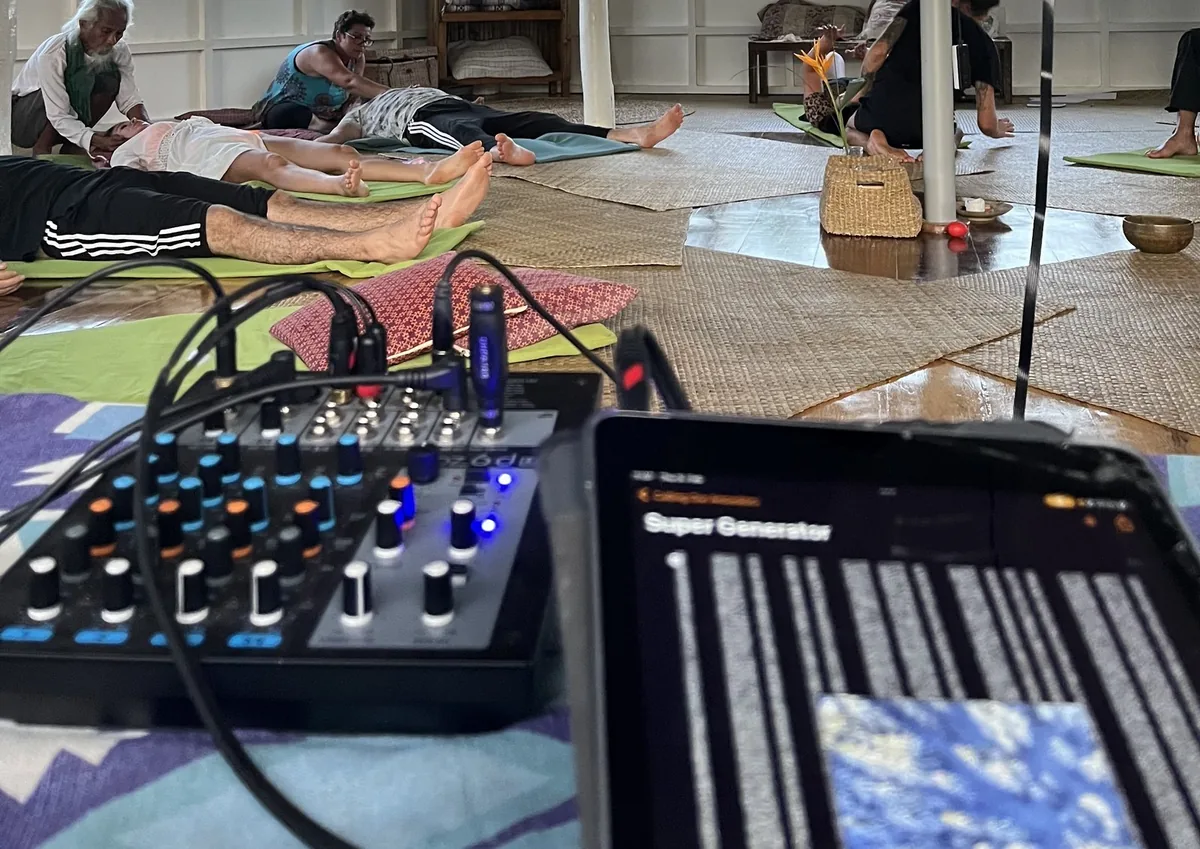
There is more to sound than what we hear. In Dreamwave trainings, we explore how to listen differently, understand sound's properties, and work intentionally with selection, layering, rhythm and movement to shape experiential space.
Explore the training →Body, brain & human experience
What happens beneath the experience?
Sound, attention and states of awareness are closely connected to the rhythms of the brain.
Brainwaves reflect patterns of electrical activity associated with different states of consciousness and attention. From slower delta and theta rhythms through alpha and beta to the much faster gamma activity, these patterns can shift as we move between rest, wakefulness, focused attention, dreaming and other states of awareness.
In Dreamwave, the layered sound journey creates a rich field of rhythm, frequency and vibration. Through auditory entrainment, rhythmic elements can interact with patterns of neural activity, supporting shifts in attention and states of awareness.
The body
A nervous system in motion
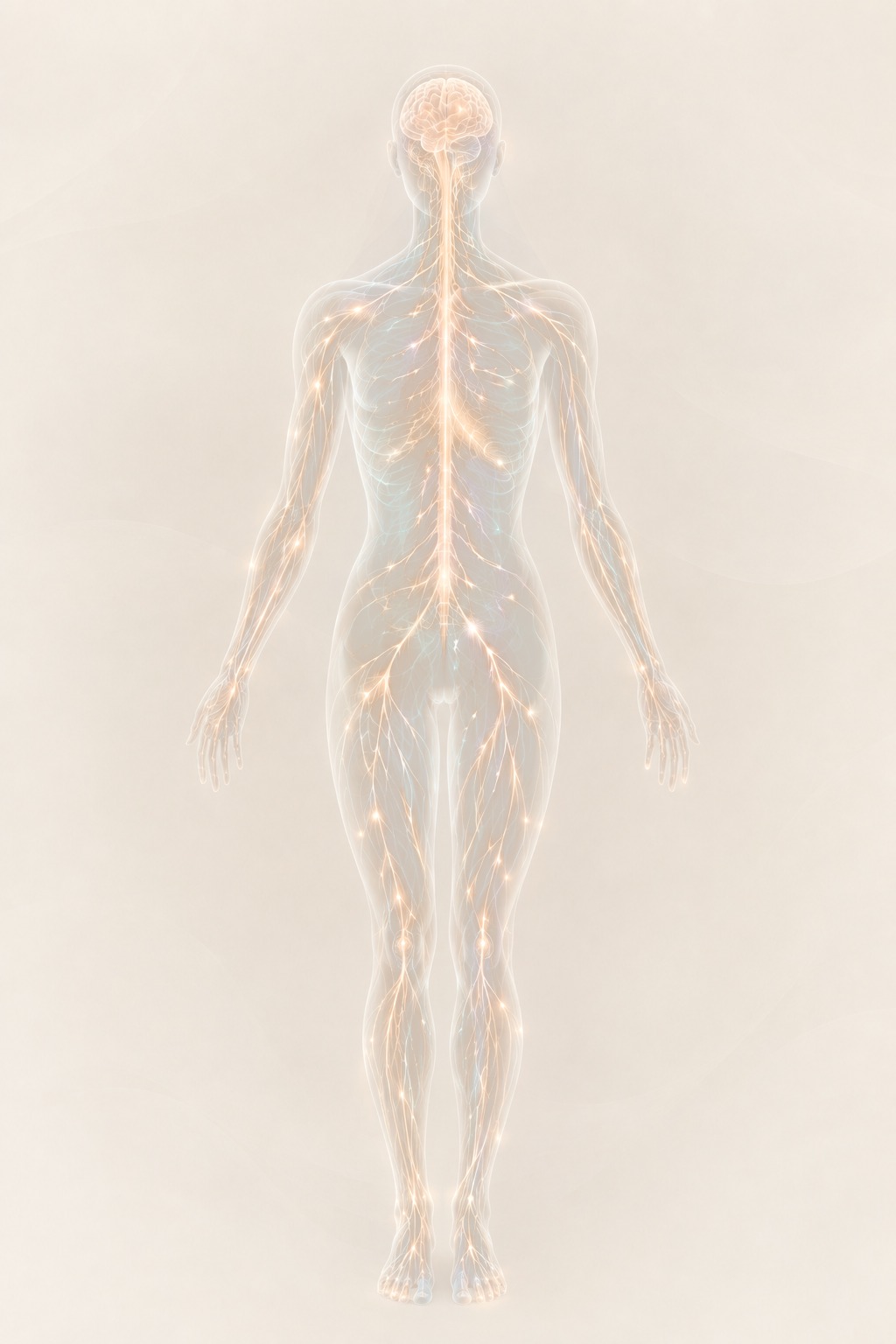
The nervous system is constantly sensing, interpreting and responding to what is happening within us and around us.
The nervous system is the network of neurons running through the brain, the spinal cord and the nerves that reach every part of the body. It senses, integrates and responds, and it keeps adapting with experience.
Engagement & Rest
The autonomic nervous system adjusts the body's state from moment to moment. The sympathetic branch supports mobilization and alertness, the parasympathetic branch supports rest and recovery, and the two work together in a constantly shifting balance. For Dreamwave, engagement and rest are parts of one living rhythm.
Attention & Perception
Perception is constructed by the brain, which selects and interprets incoming signals through attention, expectation and past experience. Attention can narrow, widen or settle, and each shift changes what we notice. For Dreamwave, this movement of attention shapes how an experience unfolds.
Sensation & Interoception
Interoception is the sensing and interpretation of signals from inside the body: breathing, heartbeat, temperature, tension, internal movement. The brain integrates these signals continuously, and they inform how we feel. For Dreamwave, turning attention toward them can deepen awareness of how we experience ourselves and move through change.
Patterns & Responses
The nervous system changes with experience, a capacity known as neuroplasticity. Repeated experiences strengthen familiar ways of perceiving and responding. For Dreamwave, new experiences create opportunities to notice these patterns and to explore different ways of responding.
Bringing this into practice
In a Dreamwave session, these ideas inform the choices we make: how sound is paced, when to leave space and silence, how a facilitator guides attention, and how the room is arranged.
The aim is a setting where your nervous system can engage, settle and notice what is happening, at its own pace, as attention moves toward sensations, emotions, thoughts and perceptions.
Our nervous systems also exist in relationship.
The people, environments and social contexts around us continually influence how we experience ourselves and respond to what is happening around us.
The relational
Change happens in relationship
We often experience change as something deeply personal, yet our lives are continually shaped by the relationships, communities, cultures and systems around us.
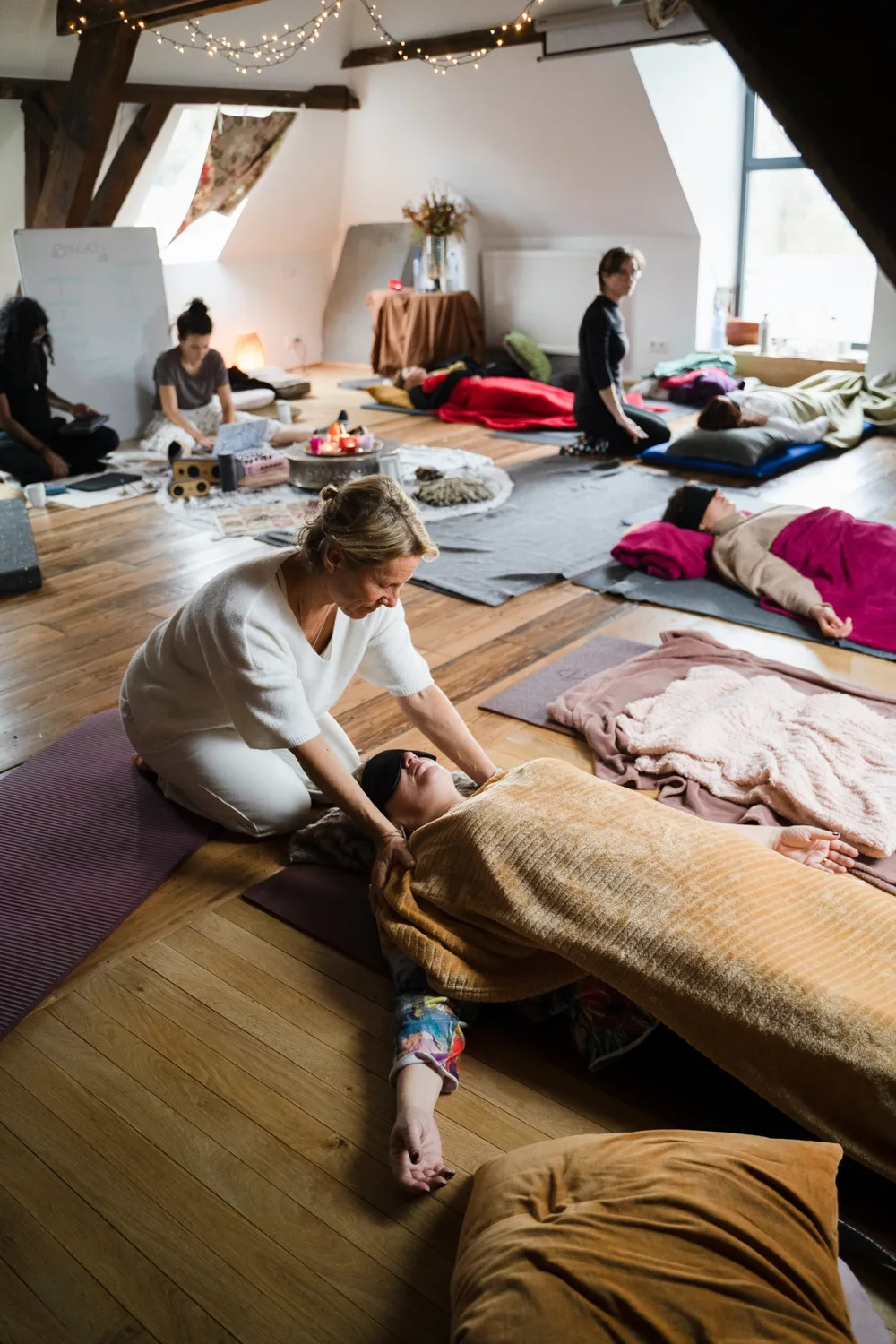
At Dreamwave, we understand change as both individual and relational: something we experience within ourselves, while being continually influenced by the people, environments and worlds we are part of.
Self
Our bodies, emotions, thoughts, histories, patterns, perceptions and ways of making meaning.
Relationship
The people we meet, the spaces we share, the groups we belong to, and the relationships through which we learn and change.
Systems
The cultures, structures, environments and wider systems that shape our possibilities, experiences and ways of relating.
We bring the whole context into the room.
Our experiences are shaped by the relationships and systems we live within. Exploring change means making space for the personal, the relational and the collective and noticing how they continually influence one another.

Wider perspectives
Dreamwave draws on different ways of knowing, learning and being in relationship. This includes learning from perspectives that understand human beings as deeply connected to community, nature and the living world, recognizing our relationship with the Earth and with more-than-human life as part of a wider web of change. This is an introduction to a larger conversation, one we continue to explore with curiosity across different knowledge traditions.
Ongoing
An evolving practice
We teach from an established foundation, staying responsive to what emerges and open to what we're still learning.
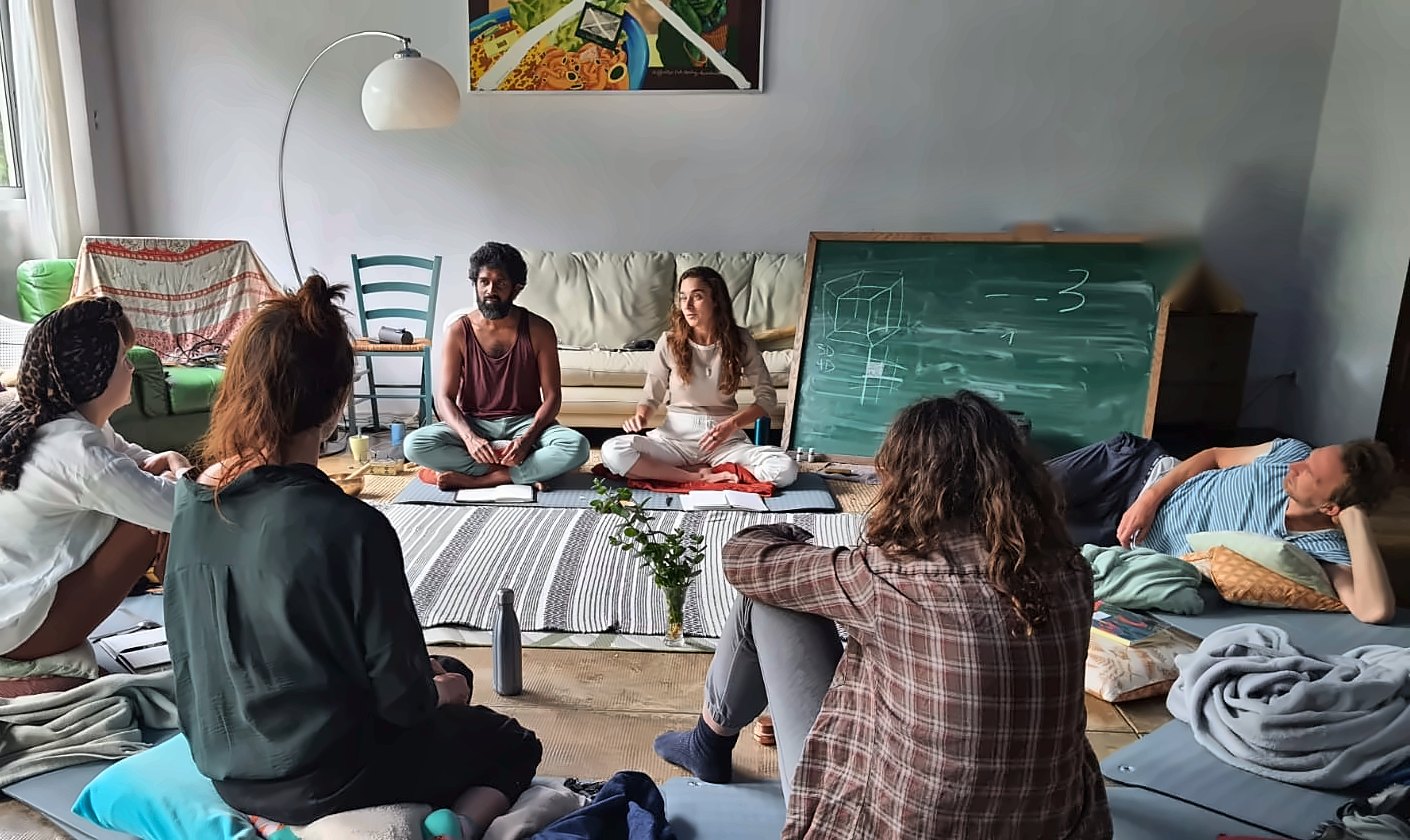
Dreamwave is an ongoing exploration of experience, knowledge and transformation, continually bringing these dimensions into relationship with one another.
Dreamwave continues to evolve through every person, community and experience we encounter.
Our core foundations give shape and continuity to the practice. They hold the knowledge, frameworks and principles that inform how we teach and create experiential spaces, while our understanding keeps growing through study, research, lived experience, teaching and the people we meet along the way.
Every training carries these foundations and makes space for what we are learning and what emerges in the room. The topics, questions and perspectives we explore can evolve from one training to the next, keeping each experience connected to the deeper foundations as it continues to grow.
Knowledge library
Explore further
Follow your curiosity into the questions, ideas and discoveries that continue to shape the practice.
Dreamwave's understanding continues to grow through study, teaching and lived experience. Our knowledge library gathers these deeper explorations in one place, a further layer into the ideas, questions and areas of knowledge that inform what we do.
Nervous system & states of awareness
Reading the body's own signals
How the nervous system senses the body from within, what research says about learning to read these signals, and how Dreamwave understands them.
Explore →Ways of knowing
Beyond the conceptual mind
Experience, intuition and lived knowledge as ways of understanding, alongside the analytical and the scientific.
Explore →Relational & collective change
How change moves through a group
What shifts when transformation is shared, and how collective spaces hold what individual practice alone cannot.
Explore →