
Before a word forms, the body has already said something. A tightening in the chest, a settling in the belly, a breath that deepens on its own. These signals arrive all day, mostly beneath notice. Neuroscience calls the sensing of them interoception.
What is interoception?
Interoception is the process by which the nervous system senses, interprets and integrates signals from inside the body[1]. It includes the beat of the heart, the rhythm of breathing, temperature, muscle tension, hunger and the movement of digestion. The neuroscientist A. D. Craig described it as a sense of the body’s physiological condition, one that may form a basis for subjective feelings, emotion and self-awareness[2].
Much of this sensing happens below awareness. Some of it surfaces as a feeling: a flutter, a warmth, a heaviness. The nervous system that receives the signal also interprets it, so what we sense is shaped by attention and by past experience.
Why does it matter?
Leading theories hold that emotional experience is closely tied to bodily change, and interoception is the route by which the brain receives that information[3]. In predictive models, the brain keeps forming expectations about the body’s state and compares them with incoming signals. What we feel emerges from that exchange[4].
What we feel emerges from the exchange between what the brain expects and what the body reports.
Researchers link differences in interoception to anxiety, mood, eating and other areas of mental health, while describing the concepts and methods as still maturing[1]. That makes interoception a meaningful place to look when exploring how people experience themselves and change.
Is sensing the body one skill?
It appears to be several. Garfinkel and colleagues distinguish three dimensions[5]. The three can differ from one another: someone can feel highly attuned and detect little, or the reverse.
Accuracy
How well someone detects an internal event, such as a heartbeat, on an objective task.
Sensibility
How strongly a person believes they sense their body, measured by self-report.
Awareness
How closely that confidence matches actual accuracy.
Questionnaires add detail. The Multidimensional Assessment of Interoceptive Awareness describes eight aspects, among them noticing sensations, listening to the body, trusting it, and using body awareness to regulate attention and emotion[6].
Can it change with practice?
Some evidence says yes, in specific ways. In the ReSource project, adults practised a body scan and breath meditation daily for three months. Compared with a control group of 80, they improved on five of the eight aspects measured[7].
The largest gains were in the regulatory aspects: using body awareness to steer attention, to settle distress and to listen to the body. Simple noticing changed little. Enjoying the practices and bringing them into daily life predicted gains better than total practice time did.
Enjoying the practice predicted gains better than total practice time.
This fits a wider picture. In their review of contemplative practice and interoception, Farb and colleagues note that heartbeat-detection accuracy in laboratory tasks has generally stayed the same after mindfulness training, while the gains appear in how people relate to and use their sensations[8]. They propose, as an idea still to be tested, that such practices loosen rigid expectations about the body and restore a sense of presence and agency.
These studies relied on self-report with healthy volunteers, so they point in a direction worth following.
What about breath and sound?
Two parts of a Dreamwave session touch the body directly: breath and sound. Research here is early.
A systematic review of slow voluntary breathing found links with higher heart rate variability, more alpha and less theta activity in the brain, and reports of more relaxation and alertness[9]. The reviewers describe the evidence as limited, with results that sometimes differed.
For music, a review in the European Heart Journal found that music can shift heart rate, breathing and mood. Exciting music raises heart and breathing rates more than calm music does, and listening tends to raise both compared with silence[10]. The effects were small, the studies varied widely, and the authors call for more rigorous work.
What we notice in practice
Sessions are participant-led. People describe what happens in many ways: sensations, vibrations, emotions, memories, images, thoughts or movement, and an experience can include both engagement and relaxation. As facilitators, we create the conditions, which are unhurried time, sound that moves and a held space, and each person’s experience unfolds in its own way.
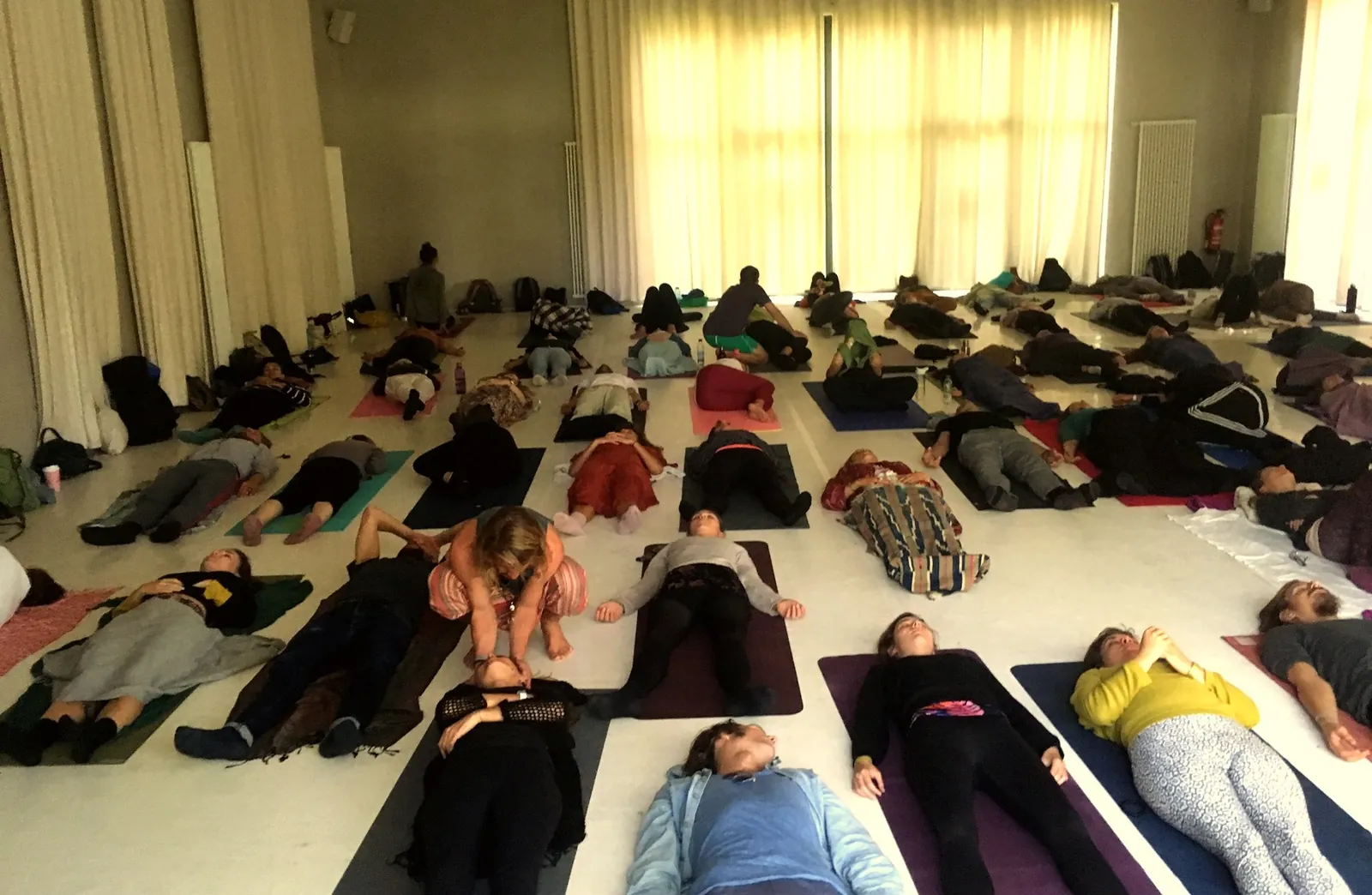
Afterwards, many people describe their experience in bodily terms: warmth, pressure, tingling, spaciousness, quiet. The language of the body arrives naturally, and it often comes with a sense of having listened closely.

Our working understanding
Here is how we make sense of it. When attention rests with the body for a while, in a room that feels held, signals that usually pass unnoticed seem to find room. Sound that moves in waves gives attention something to follow and the body something to respond to. We understand a session as a space where a person can practise sensing, interpreting and trusting their own signals, at their own pace and in their own way.
This is why facilitation at Dreamwave centres on supporting each person’s own trust in what they sense.
The meaning belongs to the person living the experience.
Questions we keep exploring
- How does the experience of sound relate to the body’s own rhythms of breath and heartbeat?
- Which aspects of interoception shift through shared, sound-led practice, and which stay steady?
- What helps a person trust what they sense?
- How does a shared space shape each person’s individual sensing?
Going deeper: the terms behind the research
Three dimensions. Interoceptive accuracy, sensibility and awareness[5] are measured separately. Heartbeat-detection tasks assess accuracy; questionnaires such as the MAIA[6] assess self-reported aspects. A person can score differently on each.
Predictive processing. In interoceptive inference[4], the brain predicts the body’s state and compares the prediction with incoming signals. Farb and colleagues describe two ways of resolving a mismatch[8]: active inference, which changes the body or environment to fit the expectation, and perceptual inference, which updates the expectation to fit the sensation. They suggest contemplative practice may shift emphasis toward perceptual inference, an idea they describe as yet to be tested.
Support matters. The same authors add that interoceptive attention is best supported by regulation skills, and that for some people it calls for more care and guidance[8].